
Model-Based System Engineering

"Systems engineering – made easy" – we live by this motto

Model-based system engineering (MBSE) does not derive its value from tool chains alone, but from clear goals, a structured approach, and active collaboration. Whether you are just getting started or want to take existing MBSE initiatives to the next level, we meet you where you are and bring structure to complexity.

Our tools support, but they do not dictate. They are the accelerator, not the replacement for engineering intelligence.
Strategy meets implementation: Your MBSE roadmap

MBSE is not an end in itself, but a means to an end.

We support you in establishing a consistent approach—tailored to your organization, your domain, and your system landscape.

  • Models that reach stakeholders: from management to engineering
  • Benefit-oriented modeling for decision-makers, developers, and architects
  • Integration into existing processes and maturity models (e.g., Automotive SPICE (ASPICE), European Cooperation for Space Standardization (ECSS), V-Modell XT)
  • Scaling to system families through Model-Based Product Line Engineering (MBPLE)
  • Design, evaluation, and optimization of future-proof memory architectures with DRAMSys
  • Linking operational, system, and software architecture

Modeling that thinks for itself

Good models are created not only through expertise but also through smart tools.

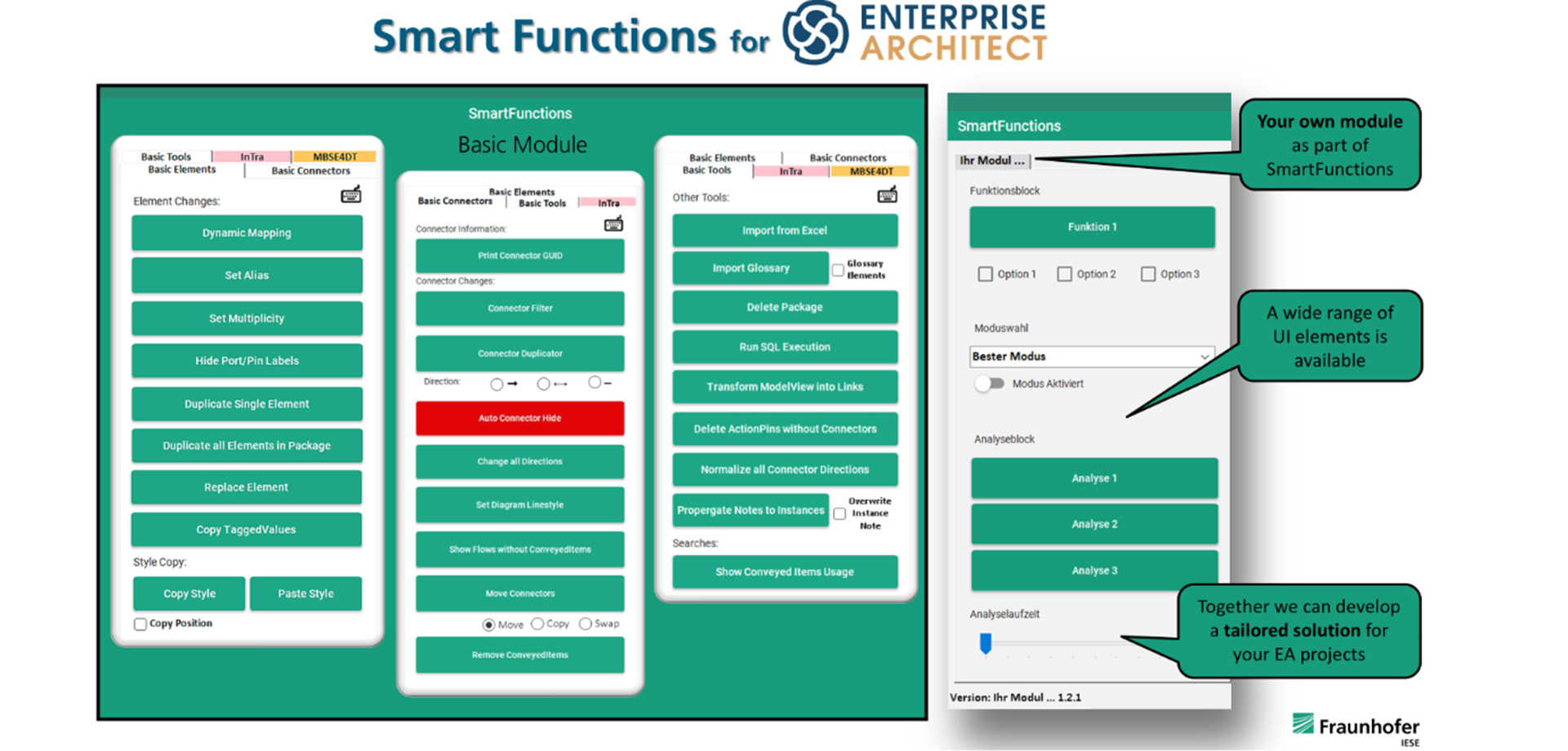
Our tool extensions for Enterprise Architect, for example, make it easy to get started and deliver effective results.

  • Clearly structured meta models and intuitive operation, ideal for beginners
  • Automated checks and reports for quality and comprehensibility
  • Prefabricated profiles for NAF, SAF, and Capella—quickly ready to go for your projects
  • Support from artificial intelligence (AI), e.g., faster model creation through smart modeling assistants or design space exploration

Our Smart Functions and PowerEA Extensions for Enterprise Architect enable efficient, standardized modeling with clear structures, automated checks, and reusable templates. 

© Fraunhofer IESE
Fewer clicks, more architecture

For complex system landscapes such as those found in the German Armed Forces , we also offer in-depth support for modeling in accordance with NAF/ADMBw – tailored to the framework for requirements fulfillment and utilization (BPN).& nbsp;
Our associated training course not only teaches methodological basics, but also demonstrates in a practical way how architectural work can be combined with specific projects.

MBSE meets digital twins

Another focus is the combination of MBSE and digital twins:

  • Model-based specifications as the basis for twin instances
  • Linking structured system models with live data – for analysis, simulation, and traceability

Experience that makes a difference

Our methodological expertise is based on real projects, not on slide concepts.

We bring together in-depth domain knowledge, tool experience, and standards compliance—for practical MBSE implementation.

  • Modeling requirements & architectures with:
    • Requirements Engineering: DOORS, Polarion, ReqSuite, Require7
    • MBSE: Enterprise Architect, Capella, Cameo, Rhapsody
    • Languages: SysML, UML, domain-specific languages (DSL)
  • Toolchain integration: traceability, digital twins, ALM/PLM coupling, simulation
  • Application experience in: Automotive, aerospace, rail transport, medical technology, defense, automation
  • Standard orientation, among others:
    • RE & SE: IREB, ISO/IEC 29148, ISO/IEC 15288, INCOSE, ISO/IEC 42010
    • Quality & Safety: ISO/IEC 25000, ISO 9126, ISO 26262, IEC 61508, DIN EN 50128
    • Security: ISO/SAE 21434
    • Aerospace & authorities: ECSS, V-Modell XT Bw, BPN (formerly CPM Bw)
  • Active participation in working groups: In the GfSE working group on System Architecture Framework (SAF) and AI in Systems Engineering (KIS), we are actively involved in shaping future standards.

From entry to anchoring

MBSE is more than a method—it is a new engineering mindset.

We support you not only technically but also in organizational change:

  • How do you establish model-based thinking under time pressure?
  • How does MBSE become true cross-disciplinary collaboration?
  • And how will it become part of everyday life—not just a flagship project?

We work with you to chart the course—pragmatically, effectively, and in a structured manner.

Take action now


Contact us!


Whether it's your first step or the next level, start where it suits you best.


We are ready when you are.

Reference projects and publications

Our concepts have been successfully implemented in industrial and research projects:

  • Architecture consulting in the defense sector: Creation of interoperable NAF-compliant models with multiple stakeholders
  • MBSE in automotive supply: Toolchain coupling for model-based requirements analysis, compliance with ASPICE
  • Plant Engineering 4.0: Development of model-driven engineering for linking automation planning and digital twins