
Virtual pharmaceutical production is becoming a key enabler of Pharma 4.0. It helps manufacturers make complex production processes more flexible without compromising validation, quality, or regulatory compliance. This need is especially urgent for Advanced Therapy Medicinal Products (ATMPs), where process variability is high and change management is particularly demanding. To address this challenge, the VIMOPROP platform provides a modular architecture for virtual pharmaceutical production. In this article, we introduce the core idea behind VIMOPROP, explain its main architectural building blocks, and show why the concept matters for industry, regulators, and research.
Quick Overview: VIMOPROP & Pharma 4.0
VIMOPROP (Virtual Design of Modular Pharmaceutical Production Processes) is an end-to-end digital platform developed by Fraunhofer IESE. It combines Asset Administration Shell (AAS) digital twins, co-simulation, and machine-readable assurance containers to enable virtual validation and automated re-certification of modular pharmaceutical manufacturing lines.
Core Capabilities
It supports the virtual design, simulation, and commissioning of manufacturing processes by combining digital twins, modular production, and integrated quality assurance in one continuous workflow.
Target Challenge
Reduces high process variability and demanding change management specifically for Advanced Therapy Medicinal Products (ATMPs).
Core Technology
Powered by the Fraunhofer FERAL co-simulation framework, AAS Dataspaces, and Digital Dependability Identities (DDIs).
Strategic Value
Demonstrates how virtual validation achieves more efficient, flexible, and regulatorily robust production.
Why virtual pharmaceutical production needs a stronger Pharma 4.0 foundation
VIMOPROP stands for VIrtual design of MOdular pharmaceutical PROduction Processes with certifiable product quality. The platform was developed to support the virtual design, simulation, and commissioning of pharmaceutical production processes while generating traceable quality evidence for validation and re-certification. As described in the public project communication published by Fraunhofer IESE, VIMOPROP contributes to Pharma 4.0 by combining digital twins, modular pharmaceutical production, and integrated quality assurance in one continuous digital workflow. The concept is built on three closely connected pillars:
The VIMOPROP concept is built on three closely connected technical pillars:
| Core Pillar | Technical Implementation | Pharma 4.0 Benefit |
|---|---|---|
| Modular Design | Production environments assembled from pre-planned, reusable modules with plug-and-produce capabilities. | Faster adaptation, easier scaling, and flexible multi-product manufacturing. |
| Virtual Planning & Simulation | Digital twins and simulation models representing physical equipment and processes realistically. | Scenario comparison and informed decisions with reduced physical trials. |
| Integrated Quality Assurance | Quality by Design (QbD), real-time QA, and traceable digital evidence integrated from the start. | Systematic connection of process changes and regulatory expectations. |
The Digital Twin Architecture behind VIMOPROP
To understand how the platform guarantees compliance, we must look at the underlying digital architecture. The VIMOPROP infrastructure is built upon four core technology blocks:
- AAS-Based Digital Twins: Each physical asset is represented by an Asset Administration Shell (AAS). These structured digital twins provide a standardized description of equipment, parameters, engineering data, and links to simulation models. As a result, they create a shared digital basis for collaboration across vendors, operators, and quality teams.
- Digital Dependability Identities (DDIs): The DDI acts as a machine-readable assurance container for qualification and certification-related evidence. It links claims, requirements, test results, process constraints, and supporting artifacts across the lifecycle. Therefore, traceability can be maintained when equipment, software, or process configurations change.
- Fraunhofer FERAL Co-Simulation Framework: FERAL synchronizes heterogeneous models and automatically compares simulation results with stored quality and compliance requirements. As a result, process logic, equipment behavior, and quality-relevant effects can be combined in one coordinated virtual validation workflow.
- AAS Dataspace for Everybody: The dataspace provides a shared and secure infrastructure for AAS models, qualification data, and simulation results. It enables controlled data sharing, traceable updates, and reliable access to verified digital asset information across organizational boundaries. In this way, collaboration becomes more robust across organizational boundaries.
How virtual validation works in practice
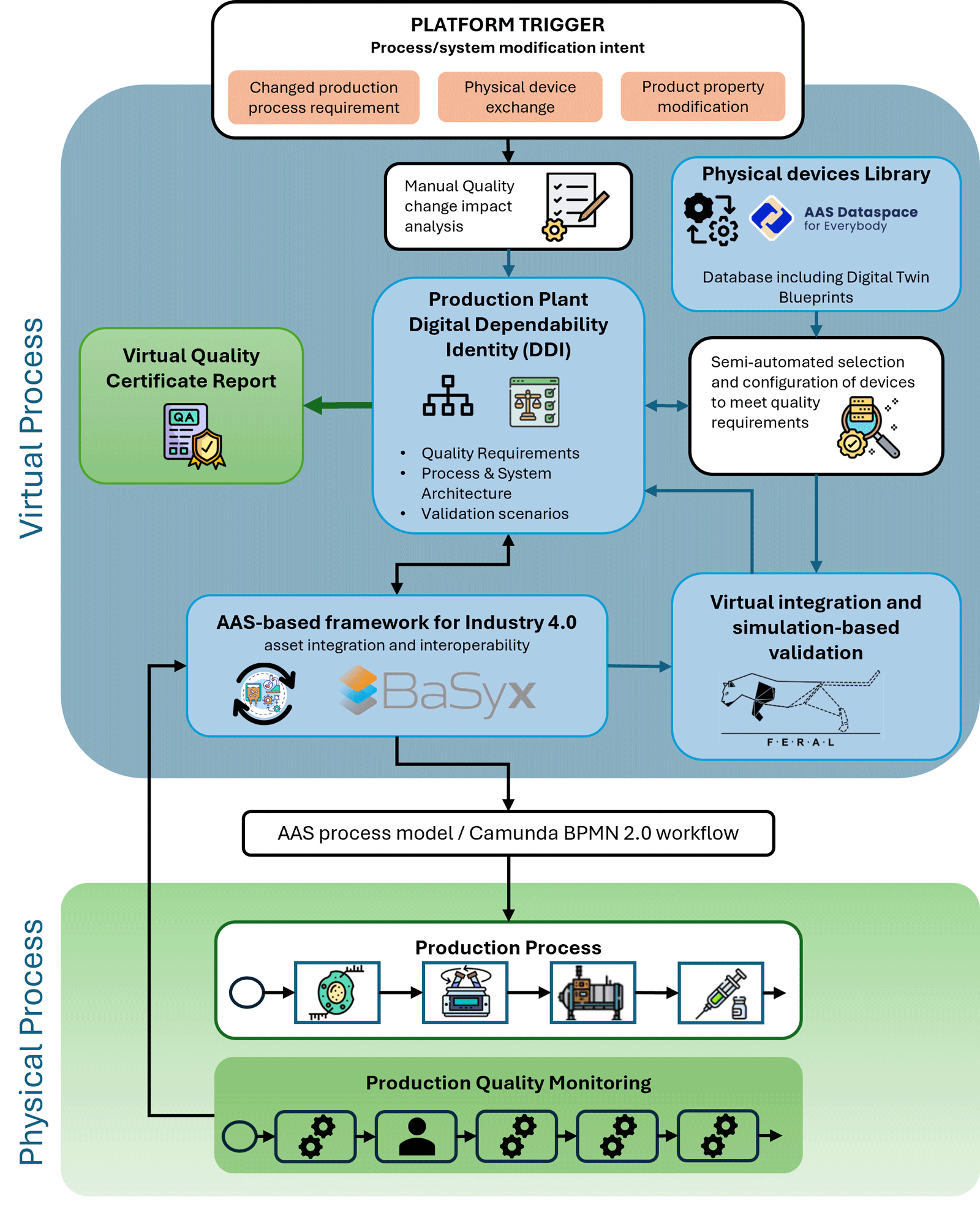
A typical use case begins when new equipment is introduced or an existing production setup needs to be adapted. The VIMOPROP platform processes production changes through an automated five-stage workflow:
Specification Phase: VIMOPROP captures the relevant process definition, quality constraints, and validation targets in a DDI-based process specification. Based on this specification, suitable assets can then be selected from a digital library.
Risk-Based Pre-Qualification: The selected assets are filtered through a risk-based pre-qualification step.
Co-Simulation Setup: The Fraunhofer FERAL framework links critical quality attributes, critical process parameters, regulatory constraints, and validation scenarios to the selected assets to generate a co-simulation setup, combining the process logic with the required device models from the AAS dataspace.
Automated Verification: Simulation results are automatically checked against predefined quality and performance indicators and written back into the DDI.
Physical Execution & Testing: Once a topology has been validated virtually, the corresponding process description is transferred to the AAS process model. Based on this validated process definition, a Camunda workflow implemented as a BPMN 2.0 model executes and controls the related test workflow on the physical equipment.
If the physical or virtual validation results do not meet the defined criteria, the platform supports iterative refinement. In that case, assets or configurations can be adapted and the validation cycle can be repeated. In this way, VIMOPROP can help production processes adapt more quickly, identify risks earlier, and reduce validation effort while maintaining regulatory confidence.
A demonstrator for lab-scale media preparation
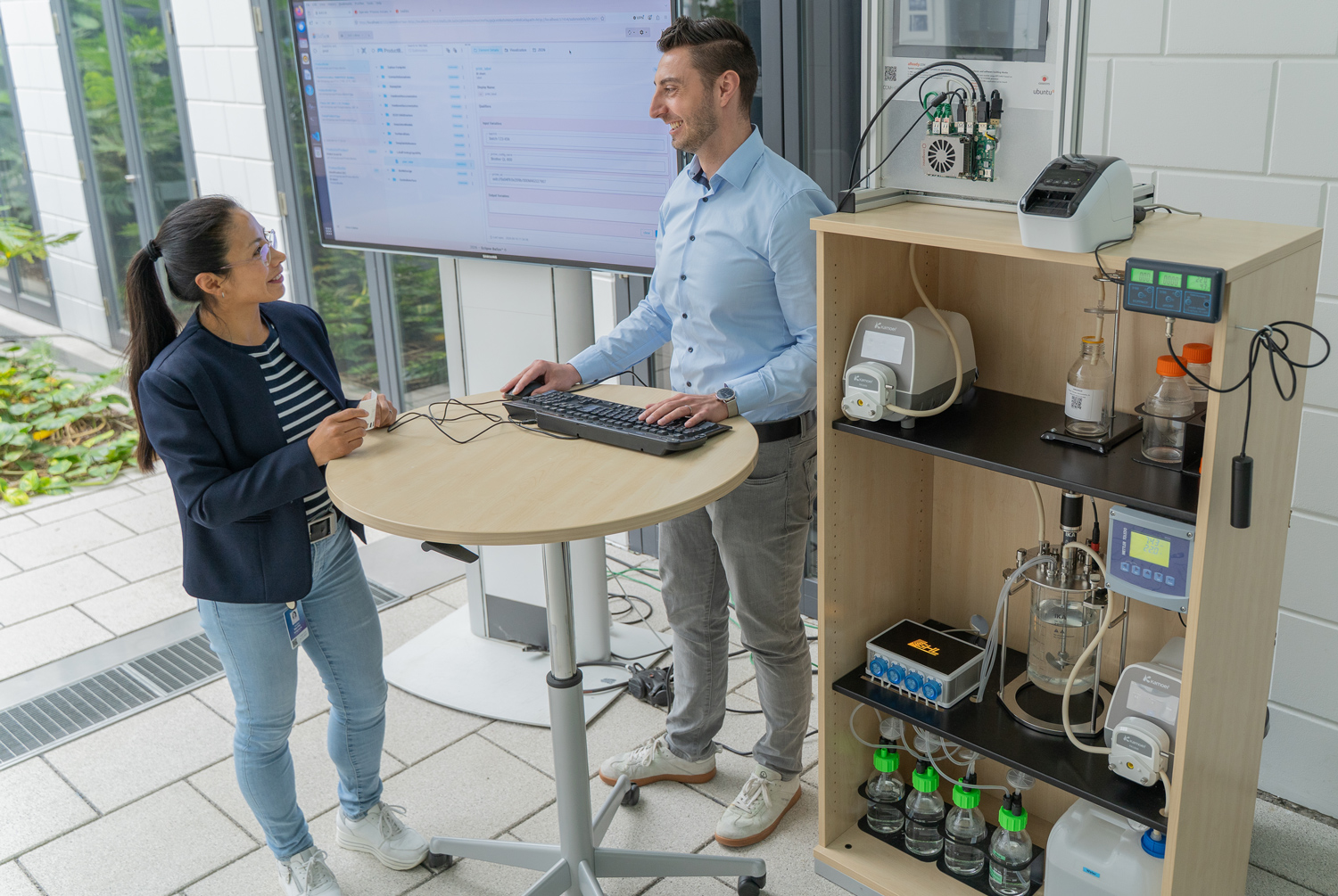
To make the concept tangible, VIMOPROP was demonstrated using a lab-scale media preparation workflow in the 2 liter range. The scenario includes dispensing, mixing, filtration, inline quality checks such as pH and pressure monitoring, and final packaging and labeling. In this setup, AAS-based digital twins represent key assets such as peristaltic pumps, mixing vessels, sterile filters, and inline sensors. In addition, associated simulation models capture pump behavior, flow control, mixing dynamics, filtration performance, and sensor responses.
For this lab-scale workflow, the DDI defines the relevant quality criteria, validation scenarios, and change-management rules. FERAL then executes a coordinated simulation of the process. Next, the results are assessed against predefined quality and performance indicators.
If the scenario fulfills the acceptance criteria, the VIMOPROP platform automatically assembles the continuous digital evidence to support a virtual certification report and targeted industrial validation or re-certification activities. If not, the workflow can be adapted and re-evaluated. In this way, the demonstrator shows in practice how virtual validation enables faster, more robust, and more transparent decision-making in pharmaceutical production.
Why virtual pharmaceutical production matters for Pharma 4.0 stakeholders
The transition to a digital twin-based framework offers distinct, measurable advantages across regulated production environments:
- More Flexibility: Modular design and co-simulation make it easier to evaluate process changes, product switches, and scale-up options before implementing them physically.
- Higher Efficiency: Virtual tests, scenario comparisons, and reduced physical trials support faster planning and more informed decisions.
- Integrated Quality Assurance: Quality by Design, real-time quality assurance, and traceable digital evidence are embedded directly into the digital workflow.
- Greater Regulatory Safety: Standardized evidence structures and automated checks can support more transparent communication with regulators and reduce validation overhead.
What this means for the ecosystem
The operational impact of the VIMOPROP platform extends across all major pillars of the pharmaceutical lifecycle:
| Target Group | Strategic & Operational Value |
|---|---|
| For Manufacturers | VIMOPROP offers a pathway to faster process adaptation, more structured change management, and better traceability across validation activities. |
| For Technology & Device Suppliers | Standardized digital asset descriptions can simplify integration and make qualification data easier to exchange and reuse. |
| For Regulators | Structured digital evidence can improve transparency and support more efficient assessment of process changes and validation outcomes. |
| For the Research Community | The platform provides a practical framework for connecting simulation, quality assurance, interoperability standards, and certification concepts in Pharma 4.0. |
What comes next
To further advance virtual pharmaceutical production, the development roadmap focuses on five key areas:
- Expanding the component library with additional device models, process templates, and qualification artifacts.
- Deepening the integration of real-time operational data with virtual models for continuous validation and anomaly detection.
- Increasing simulation fidelity to strengthen confidence in virtual validation results.
- Advancing interoperability through open standards such as the Asset Administration Shell (AAS).
- Exploring AI-supported process optimization on top of the validated digital backbone.
Practical starting points
For organizations looking to implement this Pharma 4.0 architecture, we recommend the following strategic steps:
- Start with a focused use case to establish digital twins, data models, and validation workflows before scaling further.
- Define data governance early, including ownership, access rights, and traceability requirements for shared digital assets.
- Involve quality and regulatory stakeholders from the beginning so that validation evidence is usable throughout the lifecycle.
- Build on established standards and guidance to improve interoperability and regulatory acceptance.
Closing thoughts
VIMOPROP shows how virtual pharmaceutical production can become more flexible, efficient, and regulatorily robust at the same time. It combines digital twins, modular pharmaceutical production, co-simulation, and structured quality evidence in one practical approach. As a result, the platform creates a strong digital foundation for Pharma 4.0. It also helps organizations manage change in regulated production environments with greater speed and confidence. For organizations working on ATMPs and other high-variability products, this points to a more scalable and resilient approach to pharmaceutical manufacturing.
In the next articles, we will move from concept to implementation. The second post will take a closer look at the technical architecture and system integration approach. The third will show how simulation, qualification, and digital evidence come together in an operational workflow.
Shape the Future of Pharma 4.0 with Us
Are you working on modular manufacturing or facing validation challenges with high-variability products like ATMPs? Let’s discuss how virtual validation and digital twins can transform your production workflows.