
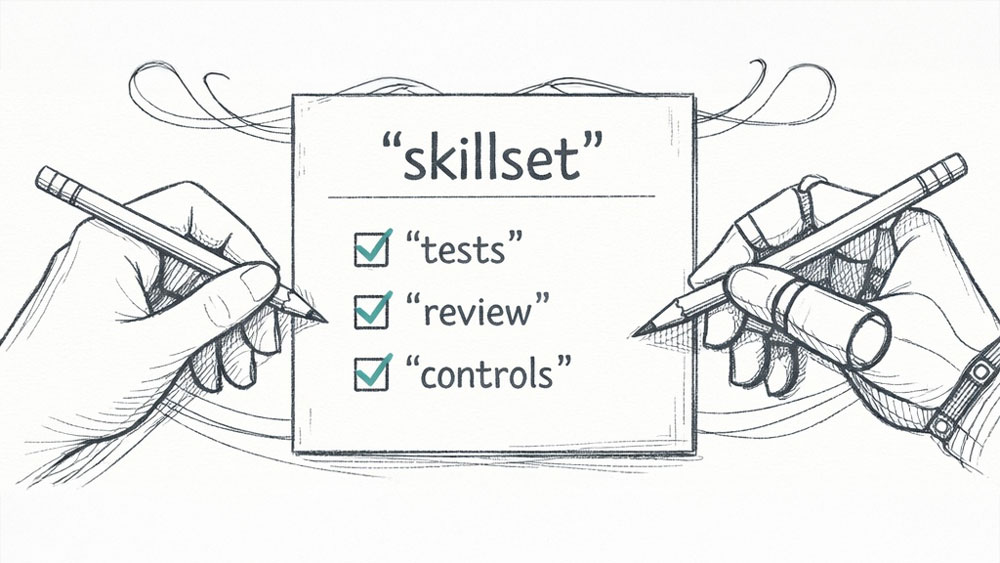
AI coding assistants rely more and more on agentic workflows. They can inspect repositories, plan changes, edit files, run tests, review their output, and call external tools. A key component of these agentic workflows is the use of skillsets: reusable instruction packages that tell agents how to perform software engineering tasks.
Sie möchten den Artikel lieber auf Deutsch lesen?
What skillsets are
A skillset can describe how an agent should plan work, write tests, review code, handle releases, or follow team conventions. In practice, these instructions typically take the form of Markdown files with YAML metadata (see Skills definitions). They contain descriptions of tasks or workflows, definitions of useful commands or tools, and guidelines outlining how things should be done. Some stay purely textual. Others might include scripts, hooks, or even a local database.
Skillsets move part of the development process into the AI context. Team rules, review routines, testing habits, and architectural preferences become instructions that an agent reads and should follow. This makes skillsets a bridge between human engineering practice and AI-assisted execution.
Overview:
Agentic Workflows, Skillsets and Function Calling
Agentic Workflows define the how of the overall process, Skillsets provide the rules for execution, and Function Calling provides the tools for interaction.
Agentic Workflows (The Process):
Describes the overarching iterative process in which an AI agent solves a task—from problem analysis and planning to code modification and test execution.
Agentic Skillsets (The Guidelines):
Structured, reusable instruction packages (often written in Markdown/YAML) that tell agents how to execute a specific task within a workflow according to team standards.
Function Calling (The Tool Interface):
The underlying Large Language Model (LLM) capability to detect and invoke external tools (such as terminal commands, Git, browsers, or databases).
Most skillsets guide behavior. A skill can tell an agent to run tests before finishing a task. It cannot guarantee that the right tests were run, that failures were interpreted correctly, or that the agent did not skip a step.
That distinction matters. A skillset is not a CI gate, a type checker, a permission system, or a branch protection rule. It belongs to the control layer of prompts and context. That layer can be useful. But it is not without uncertainty.
Current skillsets come in different forms:
- Some are prompt-only and contain Markdown instructions, checklists, and examples. Some define workflows for planning, implementation, testing, and review.
- Some guide tool use, such as shell commands, Git, browsers, or package managers.
- Some include infrastructure, for example scripts, local services, hooks, or automation around the agent.
- Some use multi-agent patterns and split work across roles such as planner, implementer, reviewer, tester, or architect.
These forms often overlap. A real skillset may combine prompt instructions, workflows, scripts, and role-based orchestration. Teams should therefore not treat all skillsets as equal. The risk depends on what the skillset can do and what the agent can access.
A read-only chat assistant has a different risk profile from an agent that can edit files, execute shell commands, access secrets, open browser sessions, and push commits (see docker horror stories). Used well, skillsets can make AI-assisted development more repeatable. Used carelessly, they can create new risks around security, traceability, cost, and overconfidence in agent autonomy. The practical question for software teams is therefore not whether skillsets are good or bad. It is how to evaluate and govern them.
What agentic skillsets can improve
Skillsets can improve repeatability. Without a skillset, an agent may approach the same task differently across sessions. With a skillset, a team can define a preferred routine. The agent may first inspect relevant files, identify tests, propose a plan, make a small change, run checks, and summarize the result.
Code review checklists, release templates, architecture guidelines, and incident procedures exist for a reason. Skillsets make some of these routines available to AI agents.
For example, a broad library such as addyosmani-agent-skills can remind an agent to consider testing, documentation, debugging, and review as part of a larger engineering workflow. A more focused skill, in the style of mattpocock-skills, can encode a narrower habit, such as how to approach a framework-specific refactoring or how to structure type-safe code changes.
Still, repeatability is not correctness. A consistently applied poor workflow still produces poor results. Teams must validate the behavior, not only admire the structure.
Skillsets can also improve task decomposition. Many agent failures happen because the task is too broad. The agent starts coding before it understands the problem. It edits too many files. It loses track of assumptions. A good skillset can slow the agent down at the right moment. It can require a plan before editing, ask for risks, force checkpoints, or tell the agent to stop when requirements conflict.
This is where prescriptive systems such as obra-superpowers are interesting. They try to shape the agent’s working style, not only its final answer. They can make the agent act more like a careful collaborator. The risk is that longer autonomous chains create more chances for small errors to compound.
Skillsets can also support onboarding into team conventions. Many teams have rules that live in documentation, code review comments, or senior engineers’ heads. A skillset can tell the agent which patterns are preferred, which files are protected, which APIs are deprecated, and which documentation is authoritative.
This can reduce repeated review comments. It can also make tacit knowledge more explicit. But it should not replace the rationale behind the rules. A skillset should link to authoritative documentation where possible.
Most importantly, skillsets turn process knowledge into an engineering artifact. They are part prompt, part documentation, part workflow, and sometimes part toolchain. That means they need ownership, review, versioning, and deletion when they become obsolete.
trending_up
Further learning: webinars on reliable LLM use
If you are interested in the practical and dependable use of LLMs beyond this article, the Team Data Science offers webinars on large language models, including both free and paid formats
The webinar series »Zuverlässiger Einsatz von Large Language Models (LLMs)« includes, for example:
- Open Source LLMs selbst betreiben
- Retrieval Augmented Generation (RAG)
- Prompting Essentials—LLMs effektiv nutzen
For organizations, we also provide customized seminars in German and English, tailored to specific goals and use cases.
Where skillsets fail
The main failure mode is simple: prompt instructions are not controls.
- A skillset can say, “Never commit failing tests.”
That is weaker than a CI gate. - A skillset can say, “Do not change generated files.”
That is weaker than file protection. - A skillset can say, “Do not introduce vulnerable dependencies.”
That is weaker than dependency scanning and review.
Comparative Analysis: Guidance vs. Deterministic Controls
| Layer | Mechanism | Capabilities | Limitations |
|---|---|---|---|
| Agent Skillsets (Probabilistic) | Prompts, checklists, SKILL.md, and sub-agent workflows | Guides agent behavior, establishes stylistic preferences, improves task decomposition | Cannot guarantee execution, susceptible to prompt injection and bypasses |
| Engineering Controls (Deterministic) | CI/CD pipelines, branch protection, static analysis, type checkers | Enforces rules strictly, blocks invalid code, prevents unauthorized commits | Lacks contextual flexibility, cannot guide the process of writing code |
This does not make skillsets useless. It means teams should use them at the right layer. Use skillsets to guide behavior and technical controls to enforce critical rules. If a rule matters, it should be backed with CI checks, branch protection, pre-commit hooks, permission boundaries, secret scanning, or human approval.
A second failure mode is overhead. A detailed multi-step workflow may help with a risky refactoring. The same workflow may slow down a small documentation fix. Multi-agent or role-based systems can spend many tokens on planning, debating, summarising, and producing intermediate artifacts. This may improve quality in some cases, but it also increases cost and review burden.
This is relevant for systems such as obra-superpowers and gstack. Their structure can be valuable for larger tasks. But for small changes, the coordination cost may outweigh the benefit.
A third failure mode is supply-chain risk. A skillset may look like documentation, but it can influence an agent with powerful tool access. A Markdown instruction can tell an agent to run shell commands. A repository can include install scripts, hooks, binaries, or local services. A workflow can ask the agent to fetch content from the network or interact with browser sessions.
This matters because AI agents often sit close to source code, credentials, build systems, issue trackers, and internal documentation. A malicious or careless skillset can cause damage even if it is “just text.” This risk grows when a skillset (for instance like gstack) carries with it specific infrastructure and runtime components.
Teams should inspect skillsets before installation. They should pin versions. They should run unknown skillsets in a sandbox. They should restrict network and shell access where possible. They should treat external skillsets like dependencies.
A fourth failure mode is false traceability. Agents can generate architecture decision records, test plans, review reports, risk assessments, and compliance notes. These documents may look official even when no expert reviewed them.
This matters in safety-related or regulated domains. A generated risk assessment is not evidence unless a qualified person reviewed and approved it. Teams need clear labels for generated drafts, protected locations for authoritative documents, and approval paths.
A fifth failure mode is missing domain expertise. A skillset can encode many rules, but it cannot reliably infer all product constraints, safety goals, threat models, regulatory obligations, or architectural trade-offs. Good skillsets should therefore require assumption logs, clarification questions, and stop conditions for decisions that need domain authority.
How industry teams should evaluate skillsets
The central question for industry is not whether a skillset looks impressive in a demo. The question is whether it improves real development outcomes under realistic constraints.
Many claims about AI coding tools rely on anecdotes, short demos, stars, or self-reported productivity. These signals are useful, but they are not enough for serious adoption decisions. Teams require evidence from their own context.
A useful evaluation follows a structured empirical approach:
- Step 1: Define a Bounded Use Case
A team might evaluate a skillset for test generation, code review, dependency updates, release notes, or migration planning. The use case should be specific enough to measure. - Step 2: Establish a Baseline
How long does the task currently take? How often do reviews find issues? How often does CI fail? How much rework occurs? How much supervision is needed? - Step 3: Measure Multi-Dimensional Outcomes
The evaluation should not only measure speed. Faster code is not useful if it creates more defects, review effort, or security findings.
Useful measures include cycle time, implementation time, review time, CI failures, regression defects, code churn, static analysis findings, unsafe dependency changes, clarification turns, supervision time, token cost, and developer experience. - Step 4: Verify Process Compliance
Process compliance also matters. If the skillset says the agent should run tests, check whether tests were actually run. If it says the agent should list assumptions, check whether the assumptions were useful. If it says the agent should inspect security-relevant code paths, check whether that happened.
The goal is not to prove that one skillset is universally better. The goal is to understand which skillsets help which teams, for which tasks, under which constraints.
Why this matters for dependable AI
Skillsets sit between several fields. They are part prompt engineering because they shape model behaviour through instructions. They are part software engineering because they encode development processes. They are part security engineering because they can influence tools, files, dependencies, and credentials. They are part dependable AI because teams may start to rely on them for repeatable behaviour.
Evaluating skillsets requires more than asking whether an agent produced code. It requires measuring task outcomes, reviewing security implications, assessing human oversight, and understanding failure modes.
The key issue is that skillsets move parts of the development process into a probabilistic control layer. That layer can improve consistency, but it cannot replace deterministic safeguards where failure matters.
For industry, the practical rule is simple: use skillsets to guide agents, use engineering controls to protect systems, and use empirical evaluation to decide whether the skillset is worth keeping.
Conclusion: Securing Agentic Workflows with Skillsets and Engineering Controls
Agentic workflows are reshaping software engineering. To make these processes repeatable and consistent, skillsets are an important step. They turn prompts into reusable process artifacts and improve onboarding, task decomposition, and review discipline.
But they are not magic. They do not enforce behaviour. They do not remove the need for expertise. They can create supply-chain risks, process overhead, false traceability, and overconfidence in agent autonomy.
Software teams should neither reject them outright nor adopt them blindly. They should start with bounded use cases, measure outcomes against a baseline, inspect skillsets like dependencies, and back prompt-level instructions with technical controls where failure matters.
info
Which AI applications are right for your business?
Are you interested in leveraging AI and want to know if it makes sense for your business? With »AI Innovation Labs«, we have developed a set of methods and tools that enable us to systematically identify, implement, and evaluate AI applications that offer clear business value.
More about LLMs and generative AI:
- Generative AI in Software Engineering: A Year in Retrospective
- Large action models (LAMs): tool learning, function calling, Agents
- Retrieval Augmented Generation (RAG): Chatten mit den eigenen Daten
- Prompt Engineering: Wie man mit großen Sprachmodellen kommuniziert
- Open Source Large Language Models selbst betreiben
- Halluzinationen von generativer KI und großen Sprachmodellen (LLMs)